Laces for trekking shoes, play a very important role. If they keep getting untied or torn, you won’t get very far! Just as important is how the laces are laced, how “fitted” the shoes are to the shape of your foot with proper lacing.

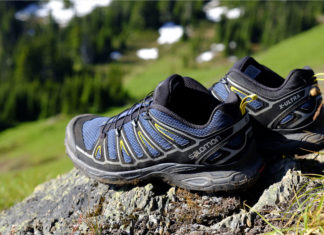
- Thedistinctive feature of trekking boots is the metal loops. They provide fast lacing and tightening, and are more reliable than textile and lurex loops. One of the main advantages of such shoes is that after fixation, the lacing remains movable, thereby not squeezing the foot and not disrupting blood circulation. The number of lace-up hooks indicates what the shoe is designed for. For example, three hooks on the shin are heavy trekking boots, two are medium and light trekking boots.
Buy trekking boots for men, women and children in the online store SportsTerritory!
- Today there are new models on the market with special clips in the ankle area. These devices help to adjust the degree of shrinkage in the lower leg and foot areas. While the laces may loosen and come undone, the clips will still hold the shoe in place.

Manufacturers distinguish several types of laces, let’s see and pick something for ourselves:
- Easy Lace – 100% silicone lacesThe Easy Lace is a 100% silicone lace that is not only easy to use, but also incredibly comfortable and convenient. They can be washed directly with the shoes. Such laces are more suitable for everyday shoes. You can use them to emphasize your individual style by choosing a bright color, as well as to experiment with lacing. Due to the excellent elasticity of these laces shoes can be removed and put on without untying them. But they are not suitable for trekking: the laces are slippery, so they will quickly come undone.
The thin round laces are also made of synthetic material
The thin round laces are also made of synthetic material, so they are washable and long-lasting. But, along with the Easy Lace models, they quickly come undone,
The Easy Lace models are not the same as the Easy Lace, so they are suitable for use with tennis shoes or summer sneakers.

- Flat laces. – a traditional accessory of sneakers and street racers.
Waxed thin laces
–
Stronger and more solid laces
which are often used in expensive men’s shoes. They hold the knot well, but are not suitable for all shoes. But, not because of their functional qualities, but because of the design.
Buy trekking boots for men, women and children in the online store SportsTerritory!
But this is more suitable for trekking:

Round medium to thicker lanyards are more reliable, durable products
. Can be made of synthetic and natural materials. For trekking shoes fit natural materials: cotton, jute, leather – they hold the knot well. But, recently, manufacturers have been offering reliable and practical synthetic laces for trekking shoes. They combined the practicality of synthetics and reliability of natural materials.
Let’s take a closer look:
Synthetic laces for trekking shoes
-
Zamberlan® round laces for hiking boots.
Have a core of particularly durable synthetic fabric and an outer coating of polyester threads. The special fiber structure guarantees maximum abrasion resistance, and the high-quality fabric prevents the laces from rotting in wet conditions.
-
Kevlar laces for extreme shoes
Kevlar is a lightweight synthetic fiber that is highly resistant to various influences, such as temperature, tensile and abrasion stresses. Kevlar fibers also have a zero stretch coefficient. According to the data provided by the developers, Kevlar™ fibers are five times stronger than steel at equal weight.

Laces are recommended for shoes with extreme conditions, in various sports, in military footwear extreme tourism and of course suitable for trekking shoes. The laces consist of a braid (composition: 65% Kevlar, 35% kapron) and a core (composition: 100% polyester). A core is added to give volume to the lanyard.
-
Polyester shoe laces are thick
Polyester fiber is a revolutionary material with elasticity, shape retention and thermal regulation properties. The above requirements are ensured by the use of the latest technologies for the production of nonwoven materials; the hollow shape of the hair “macaroni principle”. In addition, the hair itself has the appearance of a spiral spring, which allows the product to retain its shape and easy to restore it. Also suitable for trekking shoes.
Synthetic laces are said to be slippery and more likely to come undone, but that’s their only drawback, which can be corrected with proper lacing. Read about the most popular types of lacing in this article
“Laces for trekking shoes. How to Lace?”.
Alternative laces
The Salomon brand introduced an alternative to conventional laces in the early ’90s. Back then, they were often used by athletes when every second counted, no time to think about knots. QuickLace quickly tightens and loosens the shoe, providing a good grip. Additional reliability is given by the carbon fiber, which is reinforced by the lanyard.
How do I choose the length of my shoelaces?
The easiest way is to measure the length of the old shoelaces. But what to do if they are torn or even lost? A simple hole count will help you choose and order the right laces for your trekking shoes, even online. Especially for such cases, shoe manufacturers have created a special scale:
- If the shoe has 2-3 pairs of holes for the laces, then the optimal length of the laces would be 45 cm;
- 3-4 pairs of holes – 60 cm;
- From 5 to 6 pairs of holes – 75 cm;
- 6-7 pairs of holes – 90 cm;
- 7-8 pairs of holes – 100 cm;
- 8-9 pairs of holes – 120 cm;
- 9-10 pairs of holes – 140 cm;
- 10-12 pairs of holes – 180 cm;
- More than 12, but less than 19 pairs of holes – 250 cm.
Is a tip on the laces necessary?
If we’re talking about choosing laces specifically for trekking shoes, then of course the tip should be. It can be made not only of metal, but also of plastic and silicone, the main thing is that it protects the ends of the shoelaces.
Here’s a tip .
: if the edges of your shoelaces are still disheveled, and you need to go hiking in a couple of hours, use a regular tape (adhesive tape) and wrap the naughty edge of the shoelace.

Conclusion: the lacing material for trekking boots should be strong, but elastic and still hold the knot well. Suitable as models of natural materials and synthetic counterparts with reinforced core. The choice is yours!